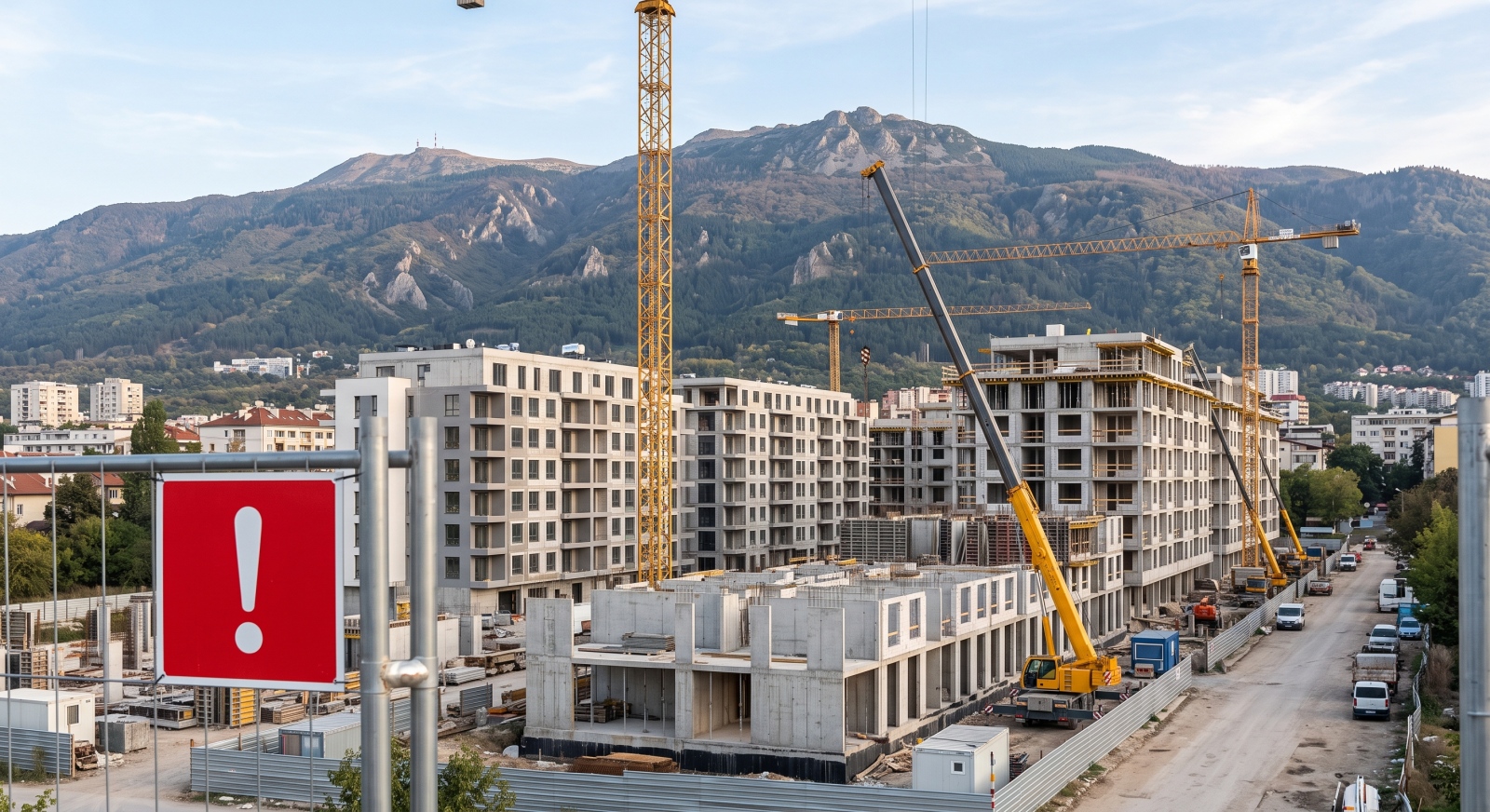
A walk through Sofia and the major regional cities in Bulgaria creates the feeling of an unrelenting construction boom. A sudden look at the horizon reveals dozens of cranes, new complexes under construction, and sales boards. However, behind this visual manifestation of growth lie fundamental market shifts.
More and more macroeconomic indicators and "behind-the-scenes" data show that the real estate sector is undergoing a turning point. Analyzing the main risk factors—from the construction sector and mortgage lending to the behavior of buyers and sellers—reveals why this moment requires extreme vigilance.
MACRO OVERVIEW: THE FIRST SIGNALS OF A TREND REVERSAL
Every real estate cycle follows a strict timeline. A market crash or correction never happens overnight—it is the result of accumulating internal oversaturation.
Data on transaction volumes for the first two quarters of 2026 registered negative signals and a slowdown in growth rates. The upcoming official data from the Registry Agency for the third quarter (Q3) of 2026 will be the critical test for the market.
Statistical Data from the Registry Agency:
For the first quarter (Q1) of 2026, the Registry Agency statistics report a total of 38,154 transactions in the country—a drop of 15.5% compared to the same period in 2025 (45,144 transactions). In Sofia, the drop for Q1 was 12.3%, in Varna 21.5%, and in Burgas 18% on an annual basis.
The trend intensified in the second quarter (Q2) of 2026, with 45,965 transactions recorded compared to 56,010 for Q2 2025—a decrease of nearly 18%. Cumulatively for the entire first half (H1) of 2026, the decline in property sales in Bulgaria reached 16.8% (84,119 transactions compared to 101,154 for H1 2025), while in the capital, the retreat stood at 14.7%.
When analyzing real estate cycles, the first indicator of a trend reversal is always a drop in transaction volume, not a direct drop in prices.
-
Phase 1: Decline in Transactions. Buyers begin to withdraw or their borrowing capacity becomes restricted, while sellers still maintain high asking prices.
-
Phase 2: Accumulation of Supply. Listings remain on the market longer, and active buyers become significantly fewer than the available properties.
-
Phase 3: Psychological Wait-and-See. A general mood of waiting develops. Buyers postpone their decisions in hopes of discounts.
-
Phase 4: Price Correction. During prolonged stagnation, sellers who urgently need liquidity are the first to lower prices, pulling the entire market down with them.
SOFIA'S PERIPHERY: THE EARLY LAKMUS TEST FOR A CRASH IN TRANSACTIONS AND PRICES
The first and clearest symptoms of a turning market cycle are already visible in the areas surrounding the capital. The periphery and towns close to Sofia usually react fastest to changes in buyer affordability and are the first segment to feel the downturn.
While just 1–2 years ago houses and properties in close proximity to Sofia sold relatively easily and quickly under the pressure of high market enthusiasm, today the picture is fundamentally different. In the periphery, a true crash in transaction volume and strong pressure for drastic price reductions can already be observed.
Interest from buyers for mass suburban listings is currently extremely scarce. Sales occur exclusively for properties with impeccable quality, clear documentation, and positioned at very attractive, buyer-favorable prices. All other listings in the periphery sit without inquiries, which is an early signal of what is about to happen in the broader metropolitan market as well.
THE CONSTRUCTION BOOM AND THE TRAP OF LEVERAGE
One of the main drivers of a potential price correction lies within the construction sector itself.
On the surface, the market appears stable, but the truth is that financially independent development companies with rich equity are a minority. A large portion of smaller and newer developers operate with high financial leverage. Their business model relies fundamentally on future installments from buyers "off-plan" to finance ongoing construction.
"Behind-the-Scenes" Signals from Developers in Sofia
Direct observations of developer behavior in the capital already reveal serious changes in their liquidity and search for buyers:
-
Hidden Bonuses and Higher Commissions: Developers are increasingly raising commission payouts to real estate agencies and offering bonuses to brokers to prioritize their projects over others.
-
Aggressive Initial Discounts: At the "Groundbreaking" stage, significantly lower prices are offered to quickly generate initial reservations and fresh capital.
When the economy slows down and "off-plan" sales drop, over-leveraged developers face an operating cash deficit. To avoid bankruptcy and cover obligations to banks and contractors, these pressurized developers will be the first to cut prices massively and sharply. This could trigger a chain reaction of price drops across the entire primary market.
THE BANKING SECTOR AND MORTGAGE DEPENDENCY
In recent years, a vast majority of property transactions—especially in Sofia, Plovdiv, Varna, and Burgas—were executed with bank financing. Historically low interest rates in Bulgaria (maintained around 2.5% – 3%) created a sense of cheap and accessible capital.
The Mortgage Reality in Numbers (2026 Data):
According to statistics from the Registry Agency and credit broker analyses, nationally around 40% of all property sales are financed through loans. In major regional centers, however, mortgage dependency is significantly higher.
In Sofia, the overwhelming majority—between 70% and 73% of residential transactions—are now completed using mortgage financing.
A crucial paradox is observed in 2026: while the total number of registered sales in the country declined by nearly 16.8% in the first half of the year, the number and volume of mortgage loans showed further growth. In the second quarter of 2026, the number of registered mortgages grew by +5.5% year-on-year, while the total volume of housing loans according to BNB data reported a massive annual increase of over 25%.
This indicates that despite the cooling in the number of transactions, buyers are using increasingly larger loans to cover high property prices, while the share of cash buyers is shrinking drastically.
This is an exceptionally high percentage that demonstrates the market's immense dependency in Sofia on bank lending. Years ago, the ratio was reversed in favor of cash purchases, but low mortgage interest rates in Bulgaria (which remain among the lowest in the entire European Union) radically altered the landscape.
This trend holds both opportunities and severe risks for buyers.
What Does This Mean for the Market?
-
Price Stability (For Now): As long as banks continue to finance buyers under favorable terms, demand remains high, supporting prices at levels over €1,500–€2,000 per sq.m for average neighborhoods.
-
Higher Risk if Rules Tighten: Since over 70% of transactions depend on mortgages, any decision by the Bulgarian National Bank (BNB) to tighten requirements (e.g., higher down payments or lower debt-to-income ratios) could abruptly cool the market.
-
Higher Interest Rates: In the event of an interest rate increase (in line with European financial markets and ECB policies), monthly loan payments for borrowers will go up.
-
Reduced Purchasing Power: Even a minimal interest rate hike of 1% to 1.5% reduces the maximum loan amount a household can service, removing a large portion of solvent demand.
-
Stricter Down Payment Requirements: At the first signs of elevated risk, BNB and commercial banks tighten down payment rules (e.g., 20%–30% instead of 10%), instantly isolating buyers without significant savings.
SECONDARY MARKET REALITY: THE STAGNATION SPIRAL
Market shifts are already felt clearly in the secondary market. The period when almost any property sold within weeks regardless of its condition is over.
Stagnation of Overpriced Properties
Currently, there is a widespread stagnation of properties with compromised quality or excessively high prices. While over the past 2–3 years the average time a property spent on the market was around 2 months, today overpriced listings sit 2 to 3 times longer.
When a property remains on the market for over 6 months, it loses buyer interest, acquires a reputation of being "problematic," and ultimately often sells at a price lower than its true market value.
Which Properties Are Actually Selling Today?
In the current market phase, transactions are successfully completed only when three mandatory factors are met:
-
Priced Correctly: The price aligns with real market comparables and the property's condition, rather than the seller's emotional expectations.
-
Quality: Homes with good functional layouts, well-maintained buildings, and desirable locations.
-
Legally Ready: Properties with fully prepared, clear documents allowing for an immediate transaction.
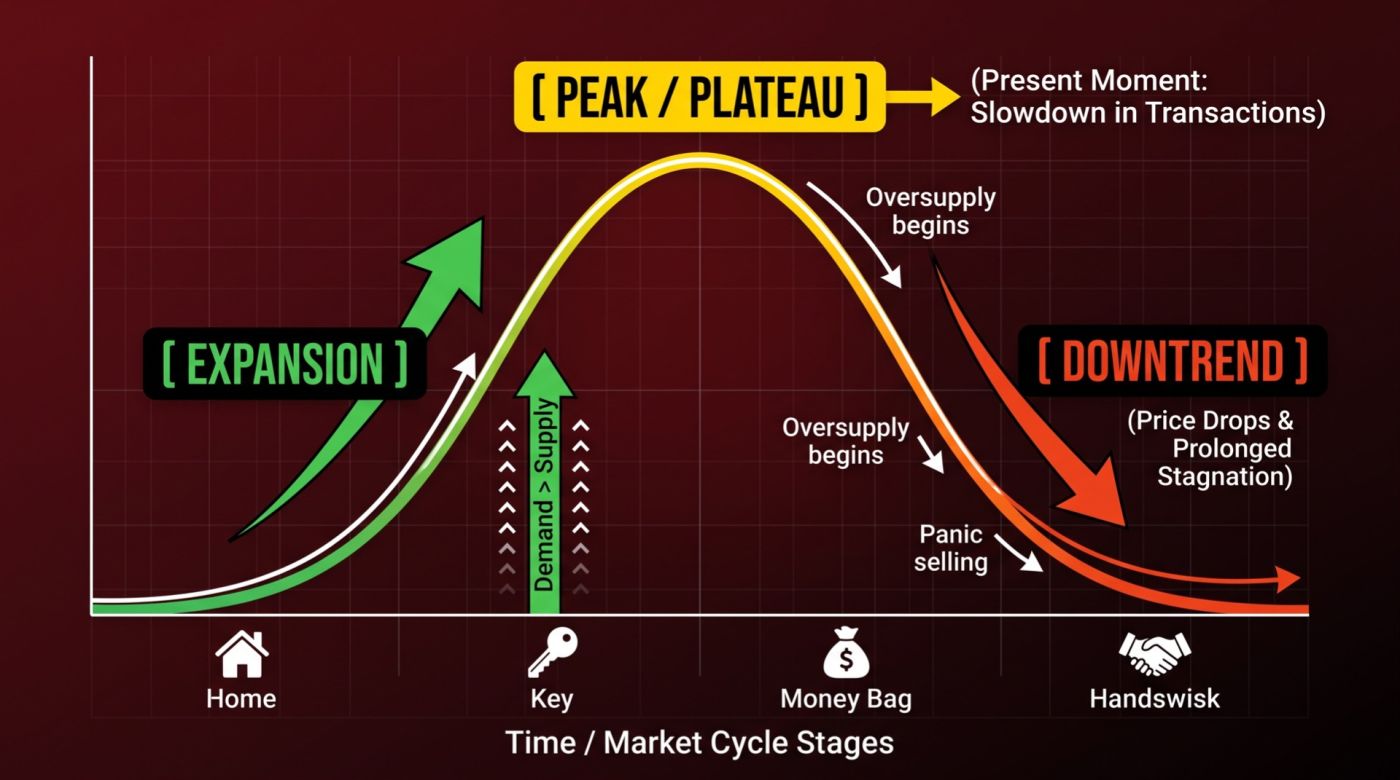
THE MARKET CURVE AND CYCLE: WHY IS IT CRITICAL TO RECOGNIZE WHERE WE ARE?
The market curve is the graphical representation of the real estate cycle. For every property owner, it is critically important to recognize whether the market is at its peak, in a plateau, or at the beginning of a downturn.
Capital Protection Strategy: Selling "On Time"
If you purchased a property 2, 3, or more years ago, you already hold a significant accumulated capital gain. The primary risk right now is having that profit erased by a subsequent market correction.
-
Why a Small Discount Today is a Profit Tomorrow: Accepting a reasonable discount of 2%–3% compared to overpriced expectations allows you to close a deal immediately and lock in your accumulated capital.
-
Avoiding Double Loss: Owners who refuse to adjust their prices at the start of a downturn usually spend months cutting prices piecemeal, only to sell in the end for 10%–20% less.
-
Turning Risk into Opportunity: Selling in a timely manner frees up liquid capital (cash). During a deeper market drop, those funds can be reinvested into significantly undervalued, high-yield assets.
PRACTICAL EXAMPLE: THE POWER OF THE RIGHT INITIAL PRICE
To illustrate how correct pricing works in practice, let us look at a recent case study from our real estate practice involving a house listed for sale.
Before officially launching the marketing campaign and posting the property on social media, the price of the house was subjected to a detailed market analysis and positioned accurately against competing offers.
The Results:
-
In less than 24 hours, over 20 inquiries were generated from direct clients.
-
On the very next day, 2 live viewings were arranged with prepared buyers.
This example proves that the market has not stopped; it has become extremely price-sensitive. When a property is priced correctly, buyers react instantly, while overpriced listings go unnoticed.
PRACTICAL ADVICE FOR SELLERS: HOW TO AVOID THE STAGNATION TRAP
-
Give Up "Testing the Market": Listing a property at an excessively high price with an "if it hits, it hits" mindset is a disastrous strategy during a cooling period. The first 3–4 weeks of listing generate the highest buyer interest. If this window is missed due to an inflated price, the listing burns out.
-
Choose a Precise Sales Strategy: Depending on the property's specifics, a clear plan must be executed—a pricing strategy, targeted marketing, or positioning the property's unique features.
-
Act Swiftly and with Market Realism: Speed in decision-making and a realistic price are the best insurance for your capital.
CONCLUSION: HOW TO APPROACH BASED ON YOUR GOALS
The real estate market in Bulgaria is not in a state of sudden crash, but it has certainly entered a phase of adjustment and slowdown. The time when every property sold on auto-pilot at any arbitrary price has come to an end. Whether the current moment is suitable for action depends entirely on your personal goals and which side of the transaction you are on.
For Buyers: Speculative Risk vs. A Home for Life
If you are currently looking for a property with a purely investment objective—to deploy free cash with the expectation of a quick resale or high rental yield—this may not be the optimal time. Entering the market at its peak carries the risk of a short- to medium-term price correction, which could reduce your expected returns.
However, if you are among the buyers looking for your first home—a place to live with your family instead of paying monthly rent or putting your life on hold—any moment is the right moment. On a long-term horizon of 10, 15, or 20 years, real estate consistently appreciates in value. A true home should never be viewed merely as a financial asset. It is the place where you will live your life, build memories, celebrate with loved ones, and call "your home." And when you step inside, what difference does it make whether in 2 or 3 years it is nominally worth €200,000 or €250,000?
For Sellers: Time for Capital Protection, Not Greed
If you are on the sellers' side and own a property that you do not live in, now is the time for a calculated analysis. Anyone who has owned a property for 2–3 years or longer is already sitting on a major capital gain. The main risk today is missing this window by attempting to "test the market" with overpriced listings.
A reasonable price today guarantees profit realization and provides liquidity. Selling in a timely manner protects you from entering the spiral of constant price cuts during a potential deeper market correction, leaving you with free capital for future great opportunities.
Whether you are buying or selling, every step in today's market must be backed by detailed analysis and a clear strategy. Analyze the data, evaluate your own timeline, and make decisions based on logic rather than emotion.
Disclaimer: This material has been prepared solely for informational and analytical purposes and does not constitute individual financial, investment, or legal advice. Before making specific decisions regarding the purchase or sale of real estate, it is recommended to consult with qualified professionals in the field.